Customer expectations are rising fast. People want instant answers, 24/7 availability, personalized service, and seamless experiences across every channel. Traditional call centers, built around manual processes and human-only teams, are struggling to keep up.
That is where the AI call centre comes in. By combining human agents with intelligent automation, virtual agents, and advanced analytics, companies are transforming support from a cost center into a powerful growth engine. According to a Metapress article on improving CX with AI call centers, leveraging AI in customer service is critical for delivering seamless omnichannel experiences and meeting rising expectations.
This guide explains what an AI call center is, how it works, and the practical benefits you can unlock when you bring artificial intelligence into your customer operations.
Modern AI call centers rely heavily on advanced computing capabilities to process massive amounts of customer data and deliver real-time insights. Utilizing high-performance distributed computing systems for AI operations ensures that customer interactions can be analyzed instantly, allowing agents and virtual assistants to respond with accurate and personalized solutions. Similarly, leveraging cutting-edge supercomputing infrastructure for predictive analytics enables organizations to run complex algorithms that forecast customer needs, detect patterns in behavior, and optimize every touchpoint across multiple channels.
Beyond technology, integrating AI insights with strategic marketing efforts amplifies customer engagement. By applying data-driven strategies to enhance online marketing campaigns and improve customer journey experiences, companies can ensure that automated recommendations align seamlessly with their broader marketing initiatives. Additionally, utilizing AI-powered techniques to optimize digital campaigns and target audiences effectively allows businesses to increase conversion rates and build long-term loyalty without overburdening human agents.
Financial management is a critical component of running a successful AI call center. Leveraging advanced financial analytics to improve cost efficiency and maximize ROI on AI investments helps organizations make smarter decisions when allocating resources, ensuring that technology investments generate measurable business value. By combining intelligent automation, strategic marketing insights, and robust financial oversight, AI call centers evolve from traditional support hubs into strategic growth engines that enhance customer experiences while driving profitability.
Top 10 AI Call Centre Solutions for Modern Customer Service
Choosing the right AI call centre platform is critical for businesses aiming to enhance customer experience, reduce response times, and streamline operations. Here’s a list of the top providers that are leading the market in intelligent call center solutions.
1. Bright Pattern AI Contact Centre Solutions
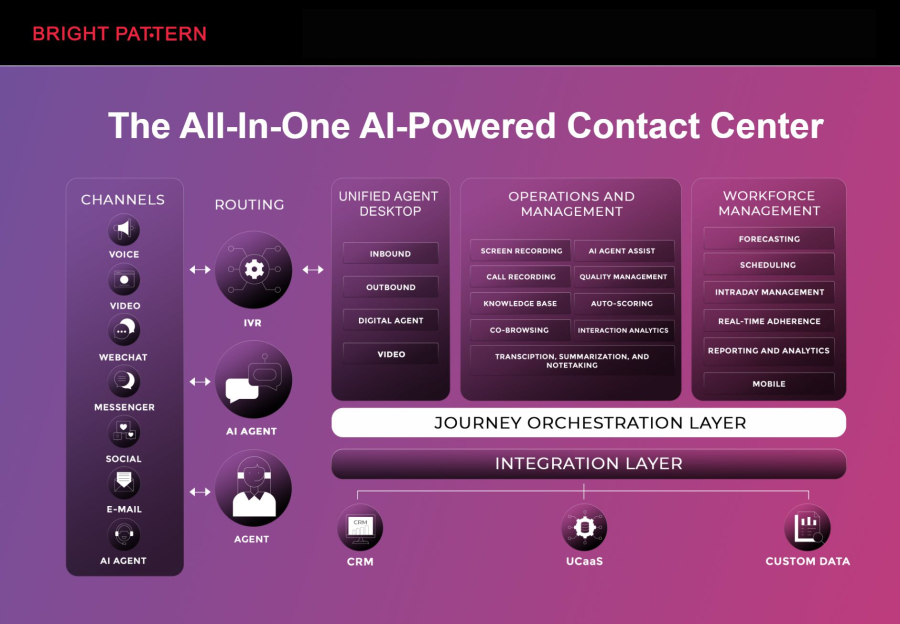
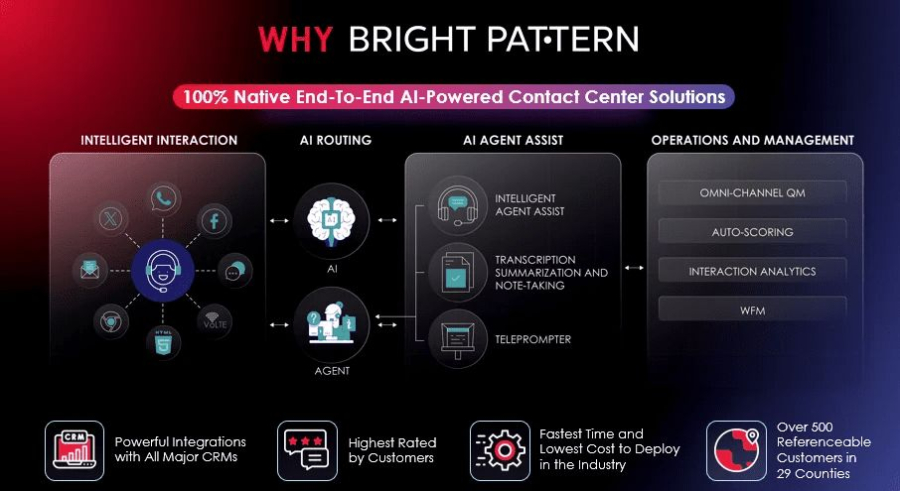
Bright Pattern is a market-leading AI call centre solution that combines advanced automation, omnichannel routing, and analytics to deliver exceptional customer experiences. Its platform allows businesses to seamlessly integrate human agents and AI-powered virtual assistants, ensuring efficient and personalized service across multiple channels.
Key features include:
- Omnichannel support across voice, chat, email, and social media
- Intelligent routing to connect customers with the most qualified agents
- AI-powered analytics for predicting customer needs and improving workflows
- Integration with CRM and marketing platforms for a unified customer view
- Real-time dashboards and reporting to monitor agent performance
Bright Pattern’s solution is particularly suitable for organizations looking to modernize their customer service operations, reduce costs, and maintain high customer satisfaction levels while leveraging AI-driven efficiency.
2. Genesys Cloud CX
Genesys Cloud CX provides scalable AI call centre solutions that combine voice, chat, and messaging. Its AI tools assist with call routing, predictive engagement, and workforce optimization.
3. Five9 Intelligent Cloud Contact Center
Five9 offers AI-enabled cloud contact center software that improves agent productivity through automation, analytics, and smart routing.
4. NICE inContact CXone
NICE inContact CXone is a comprehensive AI contact centre platform with tools for customer journey analytics, automated workflows, and AI-driven self-service options.
5. Talkdesk AI Contact Center
Talkdesk integrates AI with its cloud contact center solutions, offering predictive analytics, intelligent routing, and automated customer interactions to improve efficiency.
6. Amazon Connect
Amazon Connect provides scalable AI call centre solutions with machine learning-powered voice analytics, chatbots, and omnichannel support for better customer experiences.
7. Cisco Webex Contact Center
Cisco Webex Contact Center leverages AI for smart routing, agent assistance, and workflow automation, helping businesses optimize their contact center operations.
8. RingCentral Contact Center
RingCentral offers cloud-based AI contact center solutions that integrate customer communications, analytics, and AI-assisted service to streamline operations.
9. 8x8 Contact Center
8x8 provides AI-enhanced contact center software with features like speech analytics, virtual assistants, and omnichannel engagement to boost efficiency.
10. Vonage Contact Center
Vonage combines AI and cloud technology to deliver contact center solutions that support automated workflows, customer insights, and seamless communications across multiple channels.
What Is an AI Call Center?
AnAI call centeruses artificial intelligence technologies to handle, support, and enhance customer interactions over voice and digital channels. Instead of relying solely on human agents, AI call centers integrate tools such as:
- Virtual agents and voice bots
- Intelligent IVR (interactive voice response)
- Natural language understanding (NLU) and speech recognition
- Real-time agent assistance and coaching
- Automated quality monitoring and analytics
The goal is not to replace humans entirely, but to make every interactionfaster, smarter, and more consistentby letting AI take over repetitive tasks and support agents with real-time insights.
Key Components of an AI Call Center
While every implementation is unique, most AI call centers are built on a similar set of core components.
1. Virtual Agents and Voice Bots
Virtual agentsare AI-powered systems that can understand and respond to customer requests via voice or text. They handle routine interactions end to end, such as:
- Checking order status or delivery dates
- Resetting passwords or unlocking accounts
- Updating contact or billing information
- Providing product information or FAQs
These bots use natural language processing (NLP) and NLU to interpret what a customer is saying in everyday language. When they reach the limits of their capabilities, they seamlessly route the conversation to a human agent, often with a summary of the issue so the customer does not need to repeat themselves.
2. Intelligent IVR and Call Routing
Traditional IVR systems force customers to navigate long, rigid menus. An AI-driven IVR is far more flexible. Customers can speak freely, and the system:
- Understands intent from natural language input
- Authenticates callers using voice biometrics or data verification
- Routes calls to the best-skilled agent or appropriate bot
- Prioritizes high-value or high-urgency interactions
This leads toshorter wait timesandhigher first-contact resolutionbecause customers are connected to the right resource from the start.
3. Real-Time Agent Assistance
AI does not just interact with customers directly. It also works behind the scenes to help human agents do their jobs better. Real-time agent assistance tools can:
- Suggest next best actions during live calls
- Surface relevant knowledge base articles
- Auto-generate call notes and summaries
- Detect sentiment and alert supervisors when escalation may be needed
This reduces cognitive load on agents and helps even new team members deliverexpert-level supportfrom day one.
4. Automated Quality Monitoring and Analytics
In a traditional call center, quality monitoring relies on manually reviewing a small sample of calls. AI changes that equation completely.
With speech analytics and machine learning, an AI call center can:
- Analyze 100% of recorded calls and chats
- Track sentiment, compliance, and script adherence
- Identify coaching opportunities for individual agents
- Spot recurring issues and process gaps across the operation
The result is a continuous improvement loop that isdata-driveninstead of based on guesswork.
Top Benefits of an AI Call Center
When AI is thoughtfully integrated into your call center operations, the benefits extend across customer experience, cost efficiency, and team performance.
1. 24/7 Availability Without 24/7 Staffing
Virtual agents and AI-powered self-service tools are available around the clock. Customers get help immediately, even outside business hours or during peak demand. This leads to:
- Improved customer satisfaction and loyalty
- Reduced abandonment rates
- Stronger brand perception as a responsive, always-on partner
2. Faster Resolution and Reduced Handle Time
AI eliminates many of the bottlenecks that slow down traditional call centers. It can:
- Pre-authenticate customers before they reach an agent
- Collect basic information and context via bots
- Provide instant answers for common requests
- Guide agents to the best solution without lengthy searching
That means lower average handle time, shorter queues, and a smoother experience for every caller.
3. Lower Operational Costs
By automating repetitive and predictable tasks, AI allows your human agents to focus onhigh-value, complex interactionsthat truly require empathy and judgment. Over time, this enables you to:
- Handle more volume without proportional staffing increases
- Reduce overtime and overflow support costs
- Scale efficiently during seasonal or unexpected spikes
4. More Personalized Customer Experiences
AI thrives on data. When integrated with your CRM and other business systems, an AI call center can tailor interactions based on:
- Customer history and previous interactions
- Purchase behavior and product usage
- Preferences and communication styles
This leads to experiences that feelrelevant and proactiveinstead of generic and reactive.
5. Happier, More Effective Agents
AI does not just benefit customers. It also creates a healthier working environment for your support team. By taking over monotonous tasks, AI allows agents to:
- Focus on meaningful, challenging work
- Avoid burnout from repetitive questions or long queues
- Receive targeted coaching based on real performance data
This combination of relief and support often leads tohigher engagement and lower attritionin what is traditionally a high-turnover role.
Common Use Cases for AI Call Centers
AI can support a wide range of industries and scenarios. Here are some of the most impactful use cases.
Customer Service and Technical Support
- Resolve common troubleshooting steps using virtual agents
- Provide instant status updates for tickets or service requests
- Guide customers through self-service workflows
Sales and Lead Qualification
- Pre-qualify inbound leads using conversational bots
- Schedule appointments or demos automatically
- Gather key data points before handing over to sales reps
Billing, Payments, and Account Management
- Answer billing questions and explain charges
- Process secure payments through automated flows
- Update account details on demand
Proactive Outreach and Notifications
- Send reminders about appointments or renewals
- Deliver proactive alerts about service issues or delays
- Conduct satisfaction surveys and capture feedback
How AI Enhances the Customer Journey
An AI call center does not operate in isolation. It becomes a key part of the end-to-end customer journey, from pre-sale to ongoing support.
Before the Call
- AI-powered chatbots answer questions on the website and deflect unnecessary calls.
- Self-service knowledge bases recommend relevant articles based on user behavior.
- Predictive analytics identify customers who may need assistance and prepare tailored support options.
During the Call or Interaction
- Speech recognition and NLU capture the customer request accurately.
- Real-time analytics highlight sentiment and urgency.
- Virtual agents and human agents collaborate to resolve the issue quickly.
After the Call
- AI-generated summaries update the CRM with detailed notes.
- Feedback is analyzed automatically to identify trends.
- Proactive follow-ups can be triggered based on call outcomes.
Metrics AI Call Centers Help You Improve
Because AI provides deep analytics and automation, it empowers you to move the needle on critical call center metrics.
| Metric | How AI Helps |
| First Contact Resolution (FCR) | Intelligent routing and real-time assistance get customers to the right answer the first time. |
| Average Handle Time (AHT) | Pre-call data collection and instant knowledge suggestions reduce time spent per interaction. |
| Customer Satisfaction (CSAT) | Faster responses, 24/7 support, and personalization drive higher satisfaction scores. |
| Net Promoter Score (NPS) | Consistently positive experiences turn more customers into promoters. |
| Cost per Contact | Automation handles routine tasks at scale, lowering the cost of each interaction. |
| Agent Turnover | Better tools and less repetitive work reduce burnout and improve retention. |
Steps to Building an AI-Enabled Call Center
Transforming your traditional operation into an AI call center is a journey, but it does not have to be overwhelming. Here is a practical roadmap.
1. Clarify Your Objectives
Begin by defining what you want AI to achieve. Examples include:
- Reducing wait times by a specific percentage
- Automating a set number of high-volume use cases
- Improving CSAT or NPS scores across key segments
Clear goals help you prioritize the right capabilities and measure success accurately.
2. Map Your Customer Journeys
Analyze your existing interactions and identify where automation can add the most value. Look for:
- High-frequency, low-complexity requests
- Points where customers frequently abandon or complain
- Tasks that consume significant agent time but require limited judgment
3. Start with High-Impact Use Cases
Rather than trying to automate everything at once, begin with a focused set of scenarios such as:
- Order status and tracking inquiries
- Simple account or subscription changes
- Password resets and access issues
These quick wins build confidence with both customers and internal stakeholders.
4. Integrate AI with Your Existing Systems
To deliver meaningful results, your AI tools should connect with systems like:
- CRM and customer databases
- Ticketing and case management platforms
- Knowledge bases and documentation
- Billing, inventory, or logistics systems
This integration allows AI to access real-time data and perform actions on behalf of customers, not just answer questions.
5. Design for a Smooth Human Handoff
Even the most advanced AI will occasionally need help from a human agent. Plan this handoff carefully:
- Ensure context and conversation history transfer automatically.
- Allow customers to request a human at any time.
- Train agents to step in gracefully and build on what the AI has done.
6. Train, Test, and Iterate Continuously
AI models learn and improve over time. Monitor performance, collect feedback from agents and customers, and refine:
- Conversation flows and scripts
- Routing rules and escalation logic
- Knowledge base content and responses
This continuous optimization is where AI call centers really begin to outperform traditional models.
Real-World Impact: What Success Looks Like
Organizations that implement AI call center technologies effectively often report a powerful combination of results, such as:
- Significant reductions in wait times and call abandonment
- Higher self-service adoption, freeing agents for complex issues
- Improved satisfaction scores across both customers and agents
- More accurate forecasting and staffing thanks to better analytics
These improvements do more than cut costs. They create a customer experience that feels modern, responsive, and genuinely helpful.
Best Practices for Maximizing Value from AI Call Centers
To get the most from your investment in AI, keep these best practices in mind.
Keep Humans in the Loop
AI is most powerful as aco-pilotfor your team, not a replacement. Encourage collaboration between agents and AI tools, and make it easy for humans to step in when empathy or complex judgment is needed.
Prioritize Clarity and Transparency
Customers respond better when they understand who or what they are interacting with. Clearly indicate when they are speaking with a bot, and reassure them that a human is always available if they prefer.
Invest in Data Quality
Because AI relies on data, clean and well-structured information is essential. Align your teams around maintaining accurate customer records, updated knowledge bases, and consistent tagging of interactions.
Align AI with Your Brand Voice
Design your virtual agents and automated messages to reflect your brand personality. Even automated interactions can feel warm, respectful, and helpful when the voice and tone are intentional.
The Future of AI Call Centers
The evolution of AI call centers is accelerating. Advancements in language models, speech technology, and predictive analytics are making interactions even more natural and effective. Looking ahead, you can expect to see:
- More human-like conversations with advanced virtual agents
- Deeper personalization based on real-time behavior
- Tighter integration between voice, chat, email, and other channels
- Proactive service that solves problems before customers reach out
Organizations that embrace AI in their call centers today are positioning themselves for a future whereexceptional customer experienceis a key competitive advantage.
Bringing It All Together
An AI call center is more than a collection of tools. It is a strategic shift in how you serve customers, support your teams, and scale your operations. By combining intelligent automation with human empathy, you can deliver faster, more personalized, and more reliable support than ever before.
For businesses ready to modernize their customer experience, AI call centers offer a clear path to higher satisfaction, lower costs, and sustainable growth.
